Some values were never meant to race against time, nor can they be measured by figures or social media engagement. Hát Bội chooses for itself a life like an underground current—quiet, persistent, and remarkably loyal to its roots.
It possesses neither the ethereal elegance of the North’s Ca trù and Hát xoan, nor the sentimental, rustic charm of the South’s Cải lương. Instead, Hát Bội is a “sanctuary” of symbolism. Within its walls, human character is etched through painted masks, and moral principles are performed through majestic, stylised gestures. Perhaps we stay with Hát Bội to rediscover our primal pulse amidst a world moving far too fast.
That current is never loud, yet it never ceases. Amidst the elaborate layers of makeup and the seemingly distant, stylised movements, today’s youth find a spiritual anchor—a place where they can identify themselves within a much larger heritage. As the world opens up with endless choices and new trends, it is precisely this sense of precariousness that makes the need to return to one’s roots clearer than ever.
Hát Bội is more than just a pure artistic performance; it lies in the awakening of cultural pride. In the relentless momentum of the modern era, young people are beginning to realise that identity cannot be forged from things that are constantly changing. It must be anchored by values stable enough to preserve the national soul.
Within that quiet yet enduring flow, Hát Bội has become a “living memory” of Vietnamese culture—where every layer of makeup, every gesture, and every rhythmic performance is not merely an artistic expression, but a seamless continuation of history and the national spirit across generations.
THE “SANCTUARY” OF CHROMATIC MASKS
In the space of a Hát Bội stage, art is not merely a form of entertainment; it becomes an intellectual journey conveyed through the body, sound, and symbolism. Entering this “sanctuary,” viewers—especially younger audiences—feel as though they are stepping into a cultural structure where every value is intentionally arranged. Here, good and evil, loyalty and treachery, righteousness and malice do not exist as abstract academic concepts. Instead, they manifest directly on the faces, in every gesture, and within every gaze of the characters—theatrical signifiers that have been refined and standardised through generations of artisans.
By observing the makeup and the “spirit” (the aura) of a character, the audience can immediately sense their nature:
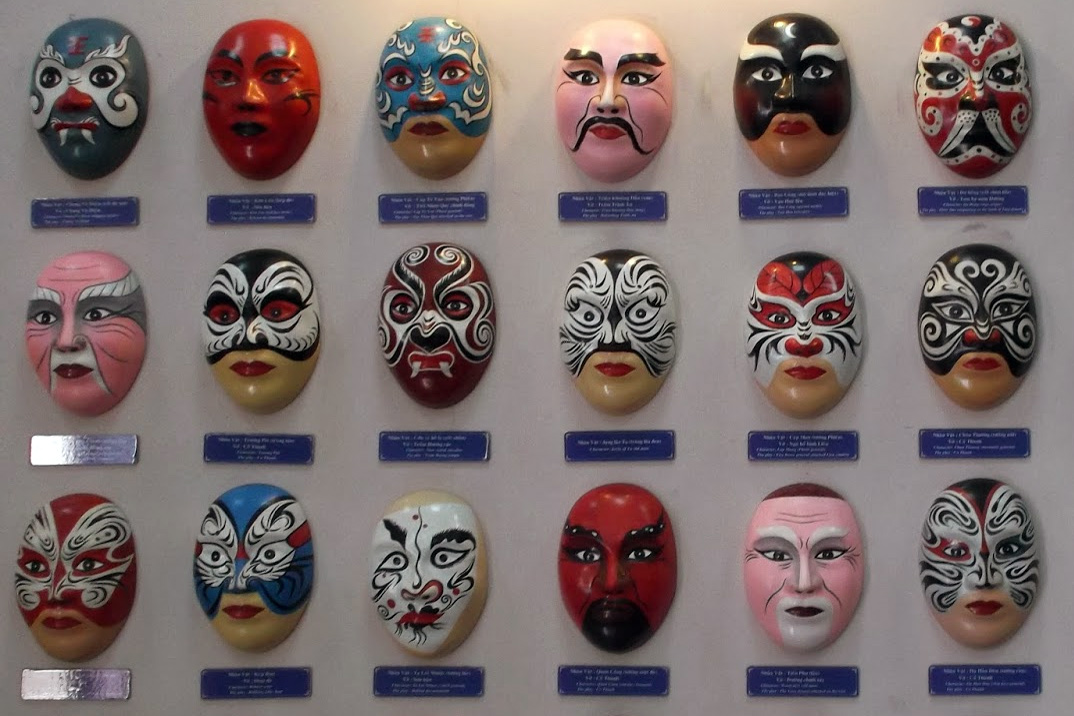
The Villains: Often bear intense and aggressive countenances with dark base tones and high-contrast patches of black, deep red, or indigo, combined with sharp, fragmented lines. The eyes are drawn deep and elongated, while eyebrows soar upward or point down like blades, evoking a sense of coldness and lethal cunning. This style of makeup transforms the face from a human visage into a symbol of deceit, cruelty, or unpredictable schemes.
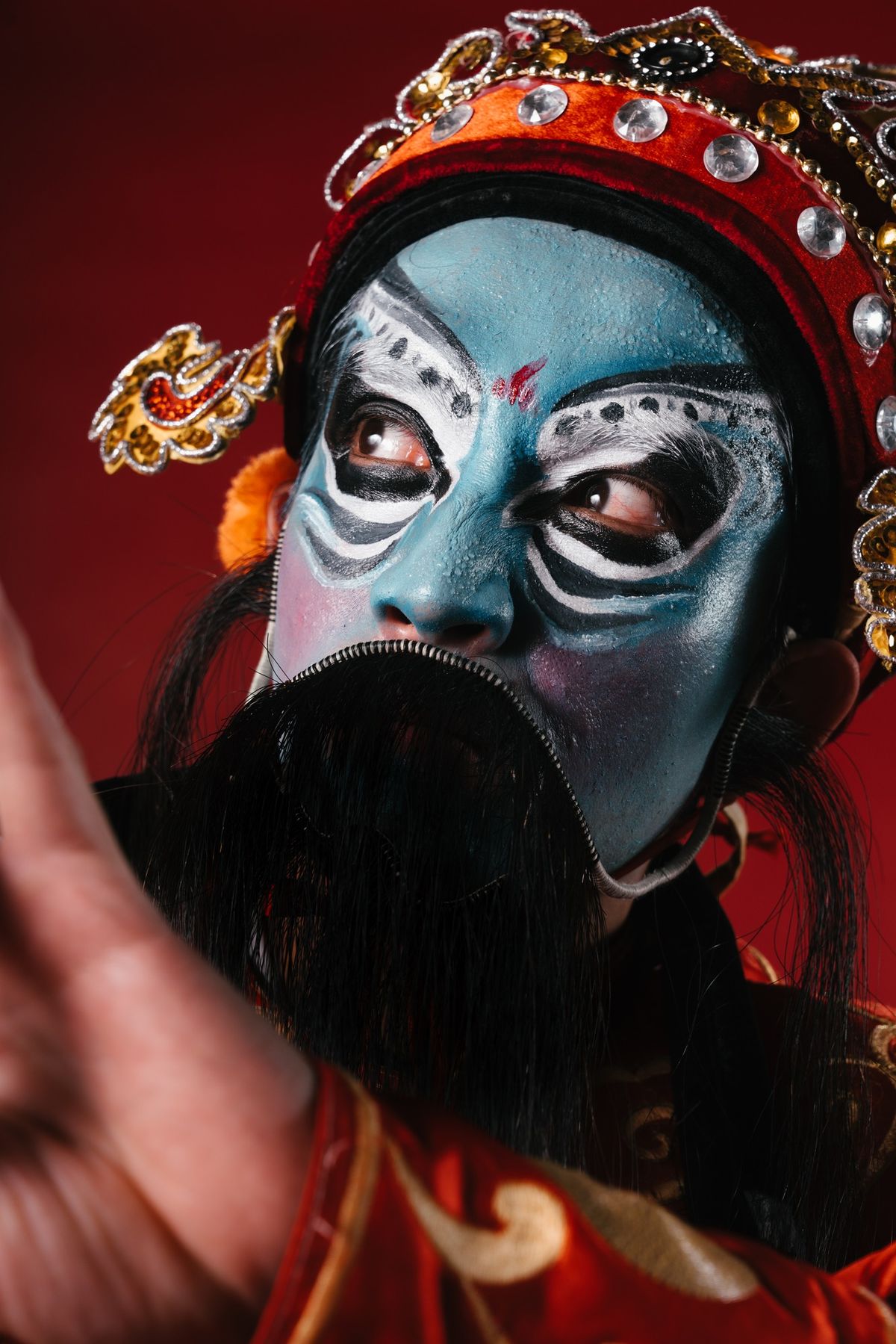
The Virtuous: Conversely, these characters appear with brighter and more balanced makeup. Shades of white, pale pink, or soft palettes are used to create a refined and harmonious face. The lines are soft and symmetrical; the eyes are wide with a clear, transparent gaze. In many plays, this design radiates sincerity and integrity at first glance. For instance, when a female lead steps onto the stage with a bright face and clear eyes, the audience instantly recognises her as an icon of honesty and compassion.
For Heroes or Loyal Officials, the makeup reaches an even higher symbolic level. Red appears as a definitive sign of loyalty and courage, paired with intricate yet decisive patterns. The face is constructed with powerful symmetry and sharp lines, featuring a piercing but never malicious gaze that reveals an unwavering inner strength. A prime example is the character Võ Tam Tư in the play Hồ Nguyệt Cô hóa cáo (Ho Nguyet Co Turns into a Fox). As a general, he is depicted with the “red face”—a classic symbol of staunch loyalty and uprightness. His majestic aura and crimson complexion allow the audience to immediately identify the archetype of an honorable military leader.
In contrast, the character Hồ Nguyệt Cô demonstrates the immense expressive power of Hát Bội through physical transformation. While still in human form, she possesses “ethereal beauty,” clad in the armour of a female warrior, spear in hand, standing gallantly on the battlefield. However, once she loses her “human pearl” and gradually regresses into a fox, her entire theatrical expression shifts: her eyes dart incessantly with wild instinct, fangs emerge as her upper lip curls, and her hands grow fur and sharp claws that seem to pierce through the skin. Her body writhes, her posture wavers—half-struggling to remain human, half-crawling like a beast. Through facial expressions, movement, and makeup alone, the audience witnesses a tragic metamorphosis unfolding before their eyes.
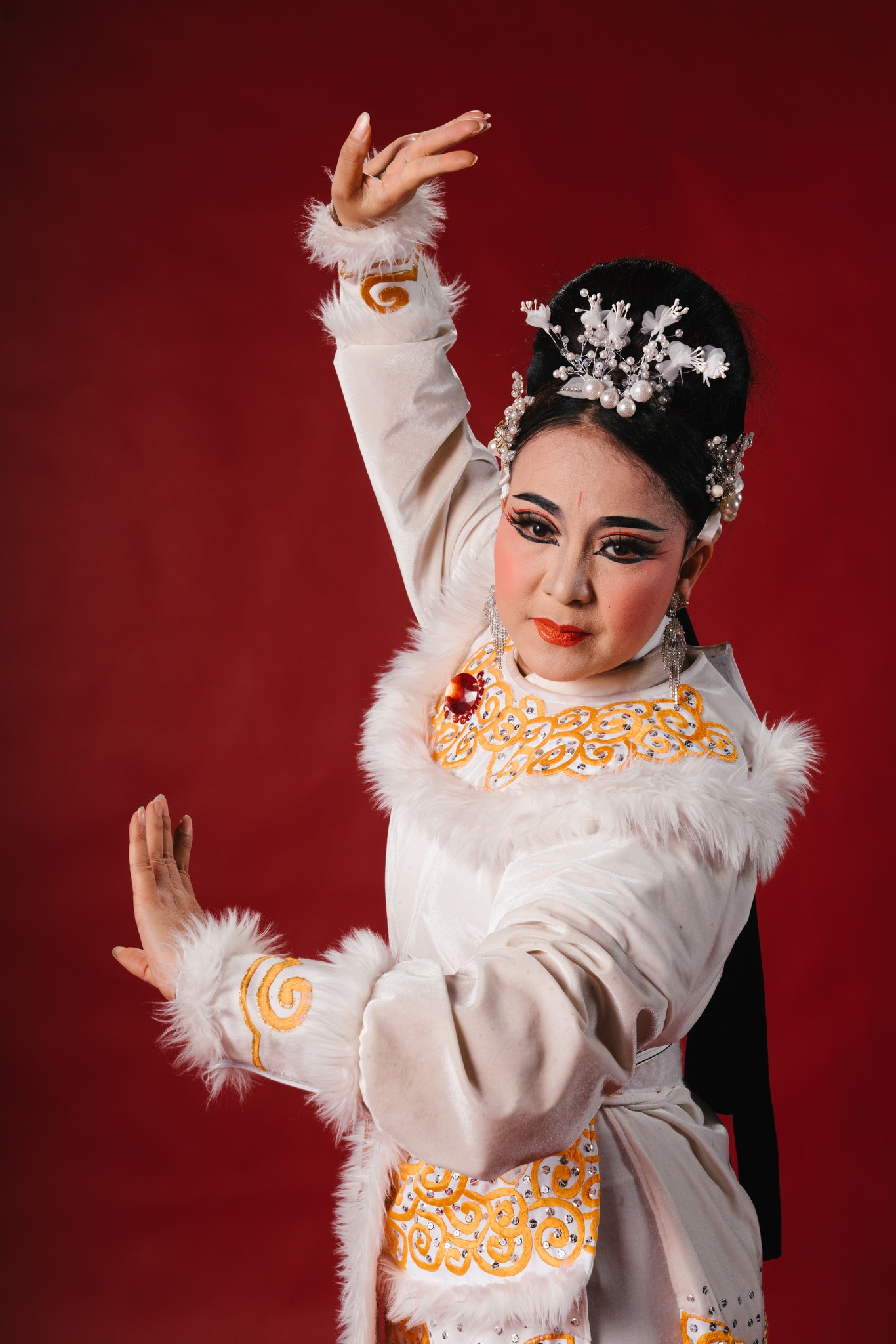
It is these seemingly small details that constitute the symbolic power of Hát Bội. Every colour and every line on a character’s face is never accidental; they form a system of theatrical semiotics that helps the audience “read” the essence of a character the moment they appear.
Therefore, this “sanctuary” of brilliant masks is not just an artistic stage; it is a place where cultural memory is awakened through countless expressive formulas refined over time. This unique “visual language” allows viewers to easily discern loyalty from treachery and witness the tragedy of a character in flux. In the world of Hát Bội, each layer of makeup does more than define a look—it carries an entire system of morality and philosophy passed down through generations of masters.
THE DRUM OF CRITIQUE – THE BEAT OF A SOULMATE’S HEART
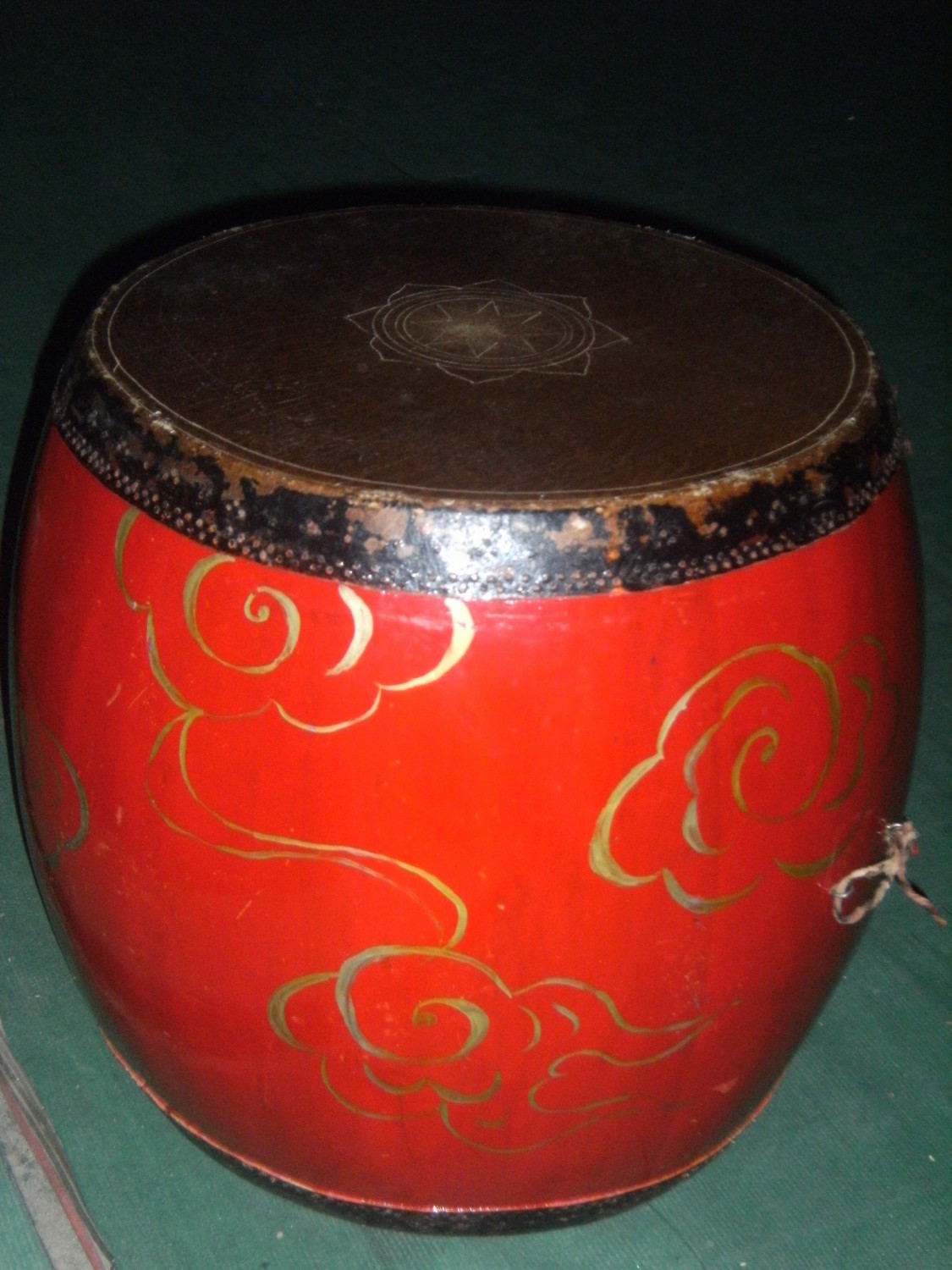
Amidst the sacred space of those chromatic masks, the sound of the Trống Chầu (the praise drum) is not merely a rhythmic guide for the performance. It becomes a language of profound empathy—a bridge where the performer and the spectator no longer stand on opposite sides but meet within the same resonance of emotion and surging cultural memory. Every beat that echoes is not just a punctuation mark for the story; it is a silent affirmation of values being carried forward through time.
The sound of the drum is an enchanting resonance between the deep, majestic “Tùng”—echoing from the taut buffalo hide—and the sharp, crisp “Tang” as the wooden mallet strikes the rim of the aged jackfruit wood. In the Hát Bội orchestra, the percussion acts as the “soul” that governs emotion. Alongside the imposing war drum on its stand, the rhythmic, hollow clacking of the bamboo slit drum (mõ tre) and the clashing brightness of the bronze cymbals (não bạt) create a multi-layered soundscape—one that feels both ancient and exhilarating.
These drumbeats vary: at times leisurely, punctuating a character’s contemplative silence; at others, rapid and relentless like a storm during climactic confrontations. It is these very vibrations that blur the line between the stage and the audience, uniting them in an underground current of cultural memory.
More importantly, through these rising and falling tones, listeners feel they are not just experiencing a form of folk art, but are engaged in a direct dialogue with their roots. Their presence is no longer one of mere observation but of deep communion—where cultural identity is perceived through intuition. The Trống Chầu serves as a silent vow, where heritage is no longer confined to the pages of history but is felt through intuition, vibrating with every heartbeat of a “Tri Âm”—a true soulmate of the arts.
THE SILENT GUARDIANS OF THE FLAME
The “keepers of the flame” do not merely perform; they carry a profound mission: to preserve an art form that has survived for centuries. Through every tour, every night performing in communal houses or village festivals, they quietly sustain values that might otherwise fade into memory.
Their days on the road, the hurried makeup sessions before the curtains rise, and the late-night strikes only to prepare for the next journey—all create a unique rhythm of life. Here, art is not just a profession; it is an identity. Few choose this path, and even fewer walk it to the end. But for those who stay, it is a choice of endurance—quiet yet steadfast, much like a flame kept alive through the years without needing to blaze brilliantly.
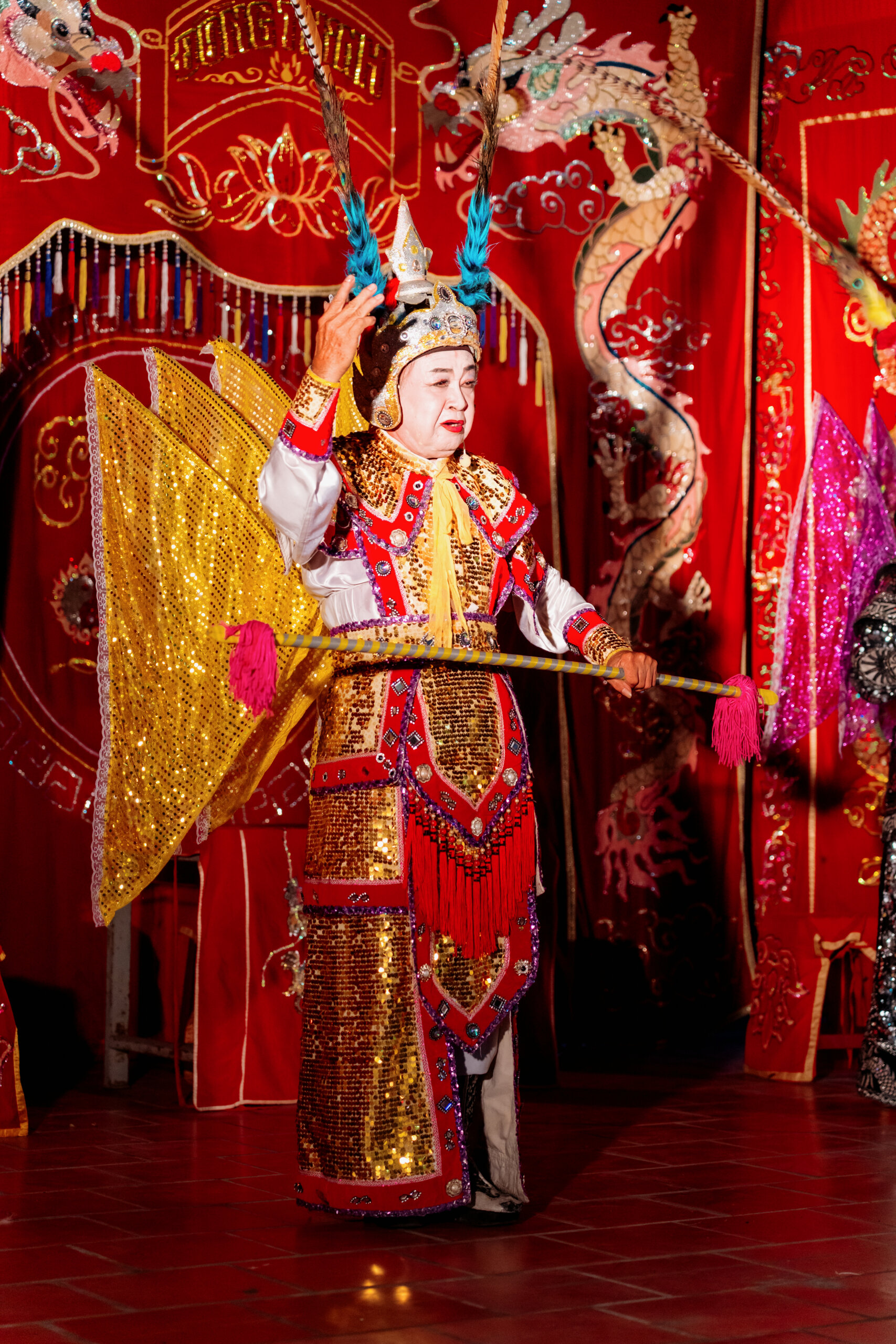
For Mr Vu Linh Tâm, his love for traditional theatre (Tuồng cổ) came as naturally as breathing. Since childhood, he wandered with his family on the “ghe hát bội” (theatre boats), travelling across Southern provinces like Ben Tre, Tien Giang, Dong Thap, and An Giang to perform. As a third-generation artist of the renowned Đồng Thinh Hát Bội Troupe of ancient Vinh Long, Mr Tâm was just thirteen when he first stepped onto the stage as a soldier carrying the signal flag. Hischildhood was filled with epic plays, the roar of applause, and the echoes of horns and drums at village festivals.
With a spirit long tethered to traditional art, Hát Bội is more than a performance type to him—it is a spiritual life renewed each day. Every layer of makeup is reapplied with the meticulous care of a sacred ritual to preserve the national spirit. Every movement is handed down like an unwritten law through generations. Every role is not merely a reenactment but a continuation of collective memory, preserved through the artist’s body and breath. Within this seemingly repetitive tradition lies a quiet yet enduring power—the power of those who refuse to leave, choosing instead to remain with their heritage.
CONCLUSION
Ultimately, the question “What keeps us staying?” is no longer a lingering doubt; instead, it settles into a clear realisation within the depths of cultural experience. What holds us back is not found in the loud or the fleeting trends of the era, but in the silent growth of cultural pride within every Vietnamese person.
It is the aspiration to maintain an identity—not as a mere slogan, but as an intrinsic choice. It is the need to preserve values stable enough to anchor ourselves amidst relentless change. Above all, it is a longing for our roots that has become more powerful than ever.
From this point of connection, Hát Bội ceases to be just a heritage site in need of preservation; it becomes a living space—a place where identity is recognised, continued, and reaffirmed through every generation. What keeps us staying, in the end, is not just the past itself, but how we choose to carry that past with us into the present and toward a future defined by authenticity.